
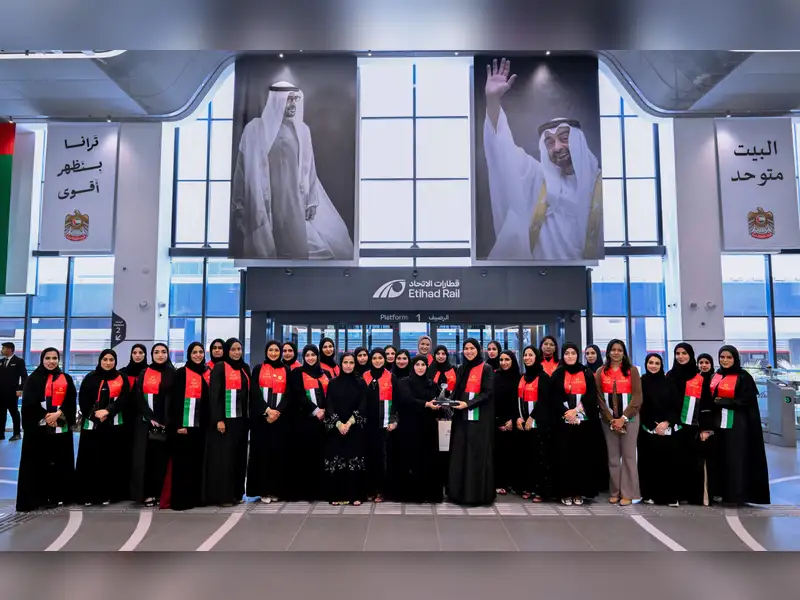
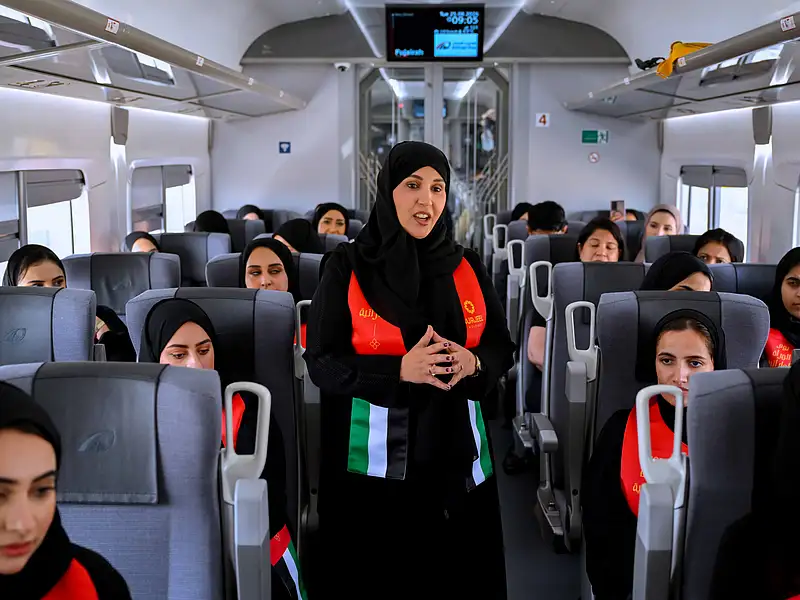
Three generations of Emirati women in healthcare came together aboard Etihad Rail to reflect on the changing opportunities available to women across the UAE’s medical and healthcare sector.
The gathering brought together doctors, nurses, clinicians, healthcare leaders and administrative professionals from different stages of their careers. Organised by Burjeel Holdings in collaboration with Etihad Rail, the Emirati Women’s Day leadership journey took participants from Abu Dhabi to Fujairah and back, creating an informal setting for conversations about career development, leadership and the experiences that have shaped Emirati women’s participation in healthcare.
The group of around 30 professionals represented different generations and a broad range of healthcare functions. Senior professionals who began their careers when pathways for Emirati women were still developing met with mid-career leaders and younger professionals preparing to take on greater responsibilities.
The discussions highlighted how opportunities have expanded over the years and how each generation has contributed to creating new possibilities for those that followed.
A changing healthcare landscape for Emirati women
For some of the senior participants, the journey offered an opportunity to reflect on the healthcare environment they encountered when they first entered the profession.
Dr Aysha Almahri, CEO of the Al Ain Region at Burjeel Holdings, recalled a period when Emirati women were not widely represented in many healthcare specialties.
“When we began our careers, Emirati women were rarely seen in many healthcare specialties. Today, it is inspiring to see the next generation stepping forward with confidence and ambition,” she said.
Her comments reflected one of the central messages of the leadership journey: the progress experienced by younger Emirati women has been shaped in part by the determination and achievements of women who entered the sector before them.
As healthcare opportunities expanded, women increasingly moved into different medical specialties as well as leadership, administration, operations and patient-service positions.
The participants’ experiences demonstrated that the transformation has not been limited to clinical professions. Women working behind the scenes in healthcare organisations also play an important role in ensuring that medical systems operate effectively.
Younger professionals looking to the future
For younger Emirati healthcare professionals, the achievements of previous generations have helped create an environment where they can approach their careers with broader ambitions.
Sara Alkatheeri, a nutritionist at Burjeel Medical City, said the achievements of women who came before her have given younger professionals greater confidence in what they can accomplish.
“Today, we have the confidence to dream bigger because the women before us broke barriers and proved what was possible. Their legacy motivates us to keep raising the bar and contribute meaningfully to the future of healthcare in the UAE,” she said.
Her comments reflected the generational nature of the programme. Rather than viewing career progress as an individual journey, participants discussed it as a continuing process in which professional experiences and lessons are passed between generations.
For younger women entering healthcare, this creates opportunities to learn from professionals who have already navigated challenges involving career progression, leadership and workplace development.
At the same time, younger professionals are entering a healthcare sector that is becoming increasingly diverse and specialised, giving them opportunities to pursue careers that may not have been readily available to earlier generations.
Bringing different healthcare roles together
The programme also sought to broaden the conversation beyond traditional medical roles.
Doctors, nurses and clinicians participated alongside professionals working in administration, operations, patient services and other functions that support healthcare delivery.
Dr Tahani Al Qadiri, associate vice president at Burjeel Training Academy, said that bringing together women from different generations and areas of healthcare offered an opportunity to understand how the sector has evolved.
“Healthcare is built by people with very different skills, but with one shared purpose,” she said.
She added that the journey brought together Emirati doctors, nurses, clinicians, leaders and colleagues from administrative functions whose careers span different generations.
According to Al Qadiri, their experiences demonstrate how opportunities for Emirati women have progressed while also showing how every generation can contribute to creating further opportunities.
The approach reflects the increasingly interconnected nature of modern healthcare. Medical professionals depend on administrative teams, operational staff, patient-service professionals and other specialists to deliver healthcare effectively.
By including professionals across these areas, the programme highlighted the contribution of Emirati women throughout the wider healthcare ecosystem.
Leadership lessons shared across generations
As the train travelled between Abu Dhabi and Fujairah, participants discussed topics including resilience, leadership, career development and national contribution.
The train provided an informal environment in which senior professionals could share their experiences directly with younger colleagues.
Conversations focused on career choices, challenges encountered throughout professional journeys and strategies for dealing with obstacles.
For younger participants, such interactions provided an opportunity to hear first-hand accounts from women who had experienced earlier stages of the UAE’s healthcare development.
For senior professionals, the discussions provided a chance to engage with a younger generation whose ambitions and expectations are evolving alongside the healthcare sector.
The programme therefore served both as a mentoring opportunity and as a platform for exchanging perspectives between generations.
Dr Farida Al Ali joins leadership journey
Dr Farida Al Ali, assistant undersecretary for National Talent Empowerment at the Ministry of Human Resources and Emiratisation, also joined the journey.
She shared insights from her leadership experience and discussed issues including resilience, career development, national contribution and the increasing participation of Emirati women across the UAE workforce.
Her participation added a wider workforce perspective to the discussions, connecting the experiences of healthcare professionals with the broader development of Emirati women’s careers across the country.
The conversations emphasised that professional development is not simply about reaching senior positions. Participants also discussed the importance of building confidence, developing skills, supporting colleagues and contributing to the UAE’s long-term development.
A journey that connected past, present and future
The Etihad Rail journey carried a symbolic significance for the programme.
As the participants travelled across the UAE, they reflected on how their individual professional journeys had developed alongside the country’s broader growth.
Senior women represented an earlier generation that entered healthcare at a time when opportunities were more limited. Mid-career professionals represented a generation helping shape the sector today, while younger participants represented the next wave of Emirati talent.
The conversations connected these three stages of professional development.
Rather than focusing solely on how much has changed, the discussions also considered how progress can continue. Participants explored the responsibility of each generation to support those who come next and to contribute to an increasingly capable and diverse healthcare workforce.
Mentorship and networking at the centre of the programme
The leadership journey included discussions focused on mentorship, networking and professional development.
By bringing together women at different points in their careers, organisers created opportunities for participants to exchange experiences and develop professional connections.
Mentorship was particularly important in the context of the programme because senior professionals could provide younger women with insights based on their own experiences, while younger professionals could offer perspectives on the changing expectations and opportunities within today’s healthcare environment.
The format also encouraged participants from different healthcare functions to understand one another’s roles and contributions.
This cross-functional interaction can help strengthen collaboration within healthcare organisations while giving professionals a broader understanding of the sector.
Continuing the progress
The gathering of three generations of Emirati women in healthcare underscored the changing role of women in the UAE’s healthcare workforce.
The experiences shared during the journey showed how career pathways have developed from a period when Emirati women were less visible in several healthcare specialties to an environment where younger professionals are entering the sector with broader ambitions.
At the same time, the discussions emphasised that progress is an ongoing process.
For the senior generation, the journey was an opportunity to reflect on the barriers they encountered and the changes they helped drive. For mid-career professionals, it provided a platform to consider their responsibility in developing the sector and supporting emerging talent. For younger women, it offered encouragement to pursue larger ambitions and contribute to the future of healthcare in the UAE.
The Emirati Women’s Day leadership journey ultimately demonstrated the importance of connecting generations.
By sharing experiences, building professional networks and encouraging mentorship, the programme highlighted how the achievements of one generation can become the foundation for the ambitions of the next.
For Emirati women in healthcare, the story is therefore not only about how far opportunities have come, but also about how today’s professionals can help shape what becomes possible for those who follow.

- Falcons of Majlis Targets UAE Startups With Serious Capital and Mentorship
- Dubai Tailoring House Suited & Booted to Open ‘World’s Largest’ Bespoke Flagship
- AIM Congress 2026: Africa Turns to Gulf Investors to Drive Its Next Growth Phase
- DUBAI CHAMBER CANVA BUSINESS: SMEs Get Free One-Year Access to AI-Powered Design Tools