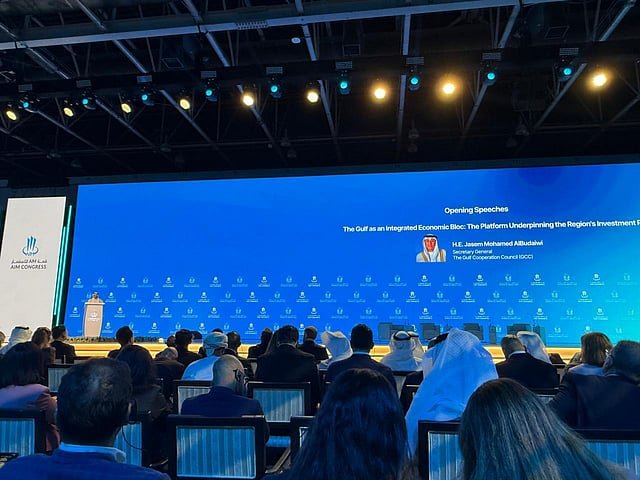
Hili Forum 2026 will bring together policymakers, diplomats, academics, government officials and international experts in Abu Dhabi on September 7 and 8 to examine the Gulf region’s changing strategic landscape.
The third edition of the forum is being held under the theme “Gulf at Crossroads: Conflict, Consequences and Course Correction”, reflecting a period of significant geopolitical and economic transformation across the region.
More than 55 speakers and 1,000 participants representing 35 countries are expected to attend the event, which will take place at The St. Regis Saadiyat Island Resort, Abu Dhabi.
The forum is jointly organised by the Emirates Center for Strategic Studies and Research (ECSSR) and the Anwar Gargash Diplomatic Academy (AGDA).
Gulf region at a strategic crossroads
The Hili Forum comes at a time when developments in the Gulf are increasingly influencing international security, energy markets, global trade and economic relations.
For decades, the Gulf has largely been viewed through the traditional lenses of energy security and regional geopolitics. However, the region’s strategic importance has expanded considerably.
Today, the Gulf sits at the intersection of military competition, economic interdependence, technological transformation, connectivity corridors and changing geopolitical partnerships.
The recent Iran-Israel-US war further demonstrated how quickly regional tensions can have consequences beyond the Middle East. Disruptions or uncertainty in the region can affect energy markets, international trade routes and broader global security calculations.
Against this backdrop, the Hili Forum will provide a platform for participants to assess the challenges confronting the Gulf while exploring potential opportunities for cooperation and strategic adaptation.
Three key areas of discussion
The agenda for Hili Forum 2026 is structured around three major areas: geopolitics, geo-economics and geotechnology.
Discussions on geopolitics will examine the future of regional security arrangements, deterrence and the changing balance of power.
Participants are also expected to explore how countries in the region can respond to emerging security challenges while developing stronger frameworks for cooperation and dialogue.
The geo-economic discussions will focus on the resilience of critical trade and energy corridors. With the Gulf serving as a major hub for international energy flows, commerce and logistics, the security of these networks remains central to regional and global economic stability.
The third pillar, geotechnology, will explore the increasingly close relationship between technology and geopolitics.
Technological advances are transforming economies, security systems and international competition. As countries compete for leadership in areas such as advanced technologies and strategic infrastructure, technology is becoming an increasingly important element of foreign policy and national security.
Middle powers and the changing international system
Another important theme of the Hili Forum will be the growing role of middle powers in shaping the international system.
As global power becomes more distributed and traditional geopolitical alliances evolve, middle powers are gaining greater influence in international diplomacy, economic cooperation and regional security.
The forum will examine how these countries can contribute to shaping the next phase of the international order and how their relationships with major global powers could influence regional developments.
For Gulf states, this evolving environment presents both challenges and opportunities.
The region’s countries are increasingly pursuing diversified diplomatic and economic partnerships, seeking to strengthen their positions in a world where strategic relationships are no longer defined exclusively by traditional alliances.
Rethinking established assumptions
The theme of this year’s forum calls on participants to reconsider established assumptions surrounding security, cooperation and global governance.
The rapid pace of geopolitical change has created a need for greater strategic foresight and more flexible approaches to international relations.
Rather than focusing solely on existing challenges, the discussions are expected to consider possible future scenarios and practical policy responses.
The forum aims to encourage constructive dialogue between policymakers, experts and academics while identifying approaches that could help manage emerging risks.
At the same time, participants will explore opportunities for greater regional and international collaboration.
Abu Dhabi’s role as a global meeting point
Abu Dhabi provides a fitting setting for discussions about the Gulf’s future.
The UAE occupies a strategic position between East and West and has developed into an important centre for diplomacy, trade, investment, technology and international cooperation.
The organisers draw a parallel between Abu Dhabi’s modern role as a meeting point for different perspectives and the historical significance of Hili.
The ancient settlement of Hili played an important role during the Bronze and Iron Ages, serving as part of the region’s historic networks of settlement, trade and interaction.
The Hili Forum takes inspiration from this legacy by bringing together diverse perspectives to discuss the challenges and opportunities shaping the modern world.
Bringing global perspectives to the Gulf
The forum is designed to connect different communities involved in shaping international policy.
Its participants include policymakers, government officials, thought leaders, academics and international experts, providing an opportunity for dialogue across government, academia and strategic research.
The presence of participants from 35 countries is also expected to broaden the discussions beyond the immediate concerns of the Gulf.
This international participation is particularly relevant as regional developments increasingly have consequences for economies and security systems around the world.
Energy markets, shipping routes, investment flows and technology networks connect the Gulf with major markets across Asia, Europe, Africa and the Americas.
As a result, understanding the Gulf’s future requires perspectives that extend beyond the region itself.
A critical moment for Gulf strategy
The Hili Forum 2026 arrives at a critical moment for the Gulf and the wider international system.
Regional governments are navigating security pressures while simultaneously pursuing economic diversification, technological development and stronger international partnerships.
The convergence of these priorities means that security can no longer be considered separately from economics, technology and connectivity.
Similarly, economic resilience increasingly depends on stable trade routes, secure energy infrastructure and the ability to adapt to geopolitical disruptions.
Technology is also becoming an essential component of this equation, influencing everything from national security and economic competitiveness to diplomacy and international cooperation.
Looking ahead
The two-day Hili Forum is expected to provide a platform for participants to examine these interconnected developments and consider possible courses of action for the future.
Its discussions will focus not only on the consequences of recent conflicts and geopolitical shifts but also on how countries can respond through dialogue, cooperation and strategic planning.
For the Gulf, the challenge is to navigate a rapidly changing international environment while maintaining regional stability and expanding opportunities for economic and technological development.
The forum’s central message is therefore closely connected to the idea of course correction: reassessing existing strategies, identifying emerging risks and developing practical approaches for a new geopolitical era.
As global experts gather in Abu Dhabi on September 7 and 8, Hili Forum 2026 will provide an important platform for examining how the Gulf can respond to the pressures of a changing world while strengthening its position as a strategic crossroads between East and West.
Post Views: 5