UAE non-oil sector growth accelerates in August
UAE non-oil sector growth strengthened significantly in August, with businesses recording their best improvement in operating conditions since December 2024 despite continued uncertainty linked to the Iran war and wider Middle East conflict.
The seasonally adjusted S&P Global UAE Purchasing Managers’ Index (PMI) climbed to 55.3 in August from 52.7 in July, marking the second consecutive month of accelerating growth.
A PMI reading above 50 indicates an improvement in business conditions, while a reading below 50 signals deterioration.
The latest data points to a broad-based improvement across the UAE’s non-oil private economy, supported by stronger customer demand, rising output and renewed purchasing activity.
According to S&P Global, the acceleration was accompanied by stronger sales momentum and a significant increase in stock building as companies sought to strengthen their ability to manage potential supply-chain disruptions.
New orders reach fastest pace since March 2024
One of the strongest signals in the August PMI survey was the performance of new orders.
New business increased at the joint-fastest pace since March 2024, suggesting that customer activity strengthened as some of the economic caution associated with the regional conflict began to ease.
The improvement in domestic demand was accompanied by a recovery in export business.
Export orders increased for a second consecutive month, following declines throughout the second quarter. The return of export growth provides another indication that businesses were seeing improving demand conditions despite continued geopolitical uncertainty.
The combination of stronger domestic and international demand helped create a more positive operating environment for UAE companies during August.
UAE output growth reaches six-month high
Output also accelerated during the month, increasing at its fastest pace in six months.
Companies surveyed by S&P Global attributed the improvement to several factors, including stronger order books, progress on existing projects and increased use of digital services by clients.
Fewer logistics challenges also supported business activity.
However, the rapid increase in demand created pressure on companies’ capacity to complete work. Backlogs of outstanding business increased sharply during August as some firms struggled to expand their operations quickly enough to meet higher workloads.
The development highlights a key feature of the UAE’s current non-oil expansion: demand is strengthening faster than some companies can increase their capacity.
Businesses build inventories to protect supply chains
The stronger growth environment also encouraged companies to increase purchasing and build inventories.
Stocks of inputs rose at their fastest rate in almost three years, according to the PMI survey.
The inventory accumulation was partly driven by businesses seeking to protect themselves from potential disruptions caused by geopolitical developments.
Companies increasingly sourced materials from domestic suppliers, while also strengthening their stocks of key inputs.
This shift towards local sourcing is becoming an important part of corporate supply-chain strategy in the UAE.
S&P Global Principal Economist David Owen said companies were actively building supply-chain resilience through localisation, with firms increasingly turning to domestic suppliers to reduce their exposure to geopolitical disruptions.
The move could have longer-term implications for the UAE’s non-oil economy by encouraging stronger links between local manufacturers, suppliers and service providers.
Supply conditions improve despite higher costs
Supply-chain conditions improved in August, with stronger trade flows and faster deliveries from nearby suppliers helping businesses secure inputs more efficiently.
The improvement contributed to a slowdown in input price inflation.
Input price inflation fell to its lowest level since February, although businesses continued to face higher costs for several important inputs.
Companies reported increases in the cost of energy, fuel, cement, steel and chemicals.
This means that while logistics and supply availability improved, cost pressures remained a challenge for businesses operating across the UAE’s non-oil economy.
For companies already facing strong demand, managing these input costs while maintaining competitive prices could remain an important consideration in the months ahead.
Employment remains a weak spot
Despite the stronger performance across orders and output, employment did not follow the same upward trend.
Employment declined for the second time in three months.
S&P Global said some businesses remained reluctant to increase hiring because of continued uncertainty surrounding the regional conflict.
The divergence between rising workloads and weaker employment growth also contributed to the sharp increase in outstanding work.
Companies appear to be responding to stronger demand by increasing productivity, purchasing inputs and using existing capacity rather than immediately expanding their workforces.
If demand continues to strengthen, however, sustained increases in backlogs could eventually encourage companies to expand hiring.
Business confidence improves
Expectations for future activity also improved during August.
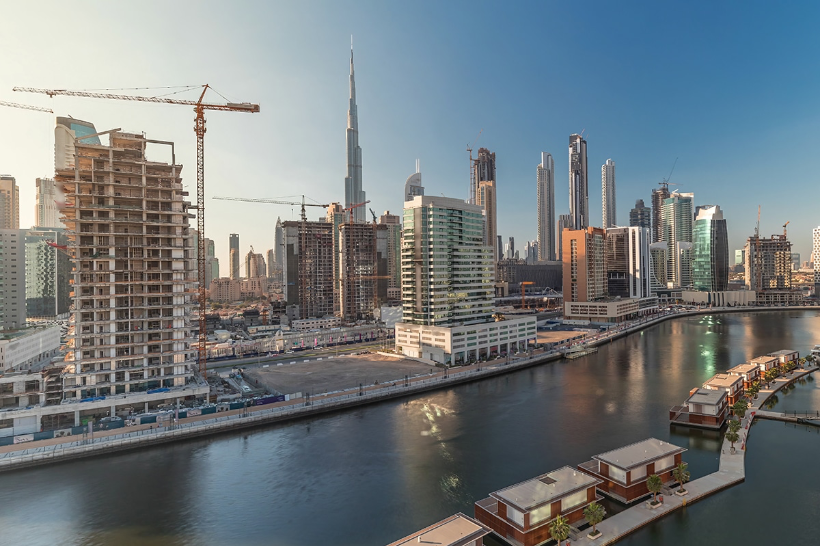
Business confidence reached its highest level since April, with companies highlighting stronger sales trends, the return of construction projects and expectations that regional tensions would ease.
The construction sector is particularly important for the UAE’s broader non-oil growth outlook, given the scale of infrastructure, real estate and development activity taking place across the country.
David Owen described the latest performance as a decisive acceleration in the UAE’s non-oil economy.
He said the August PMI represented the fastest improvement in business conditions since December 2024 and indicated that companies were adapting more effectively to the current market environment.
The latest data therefore suggests that the UAE’s private-sector economy has remained resilient despite the disruption and uncertainty associated with regional geopolitical developments.
Saudi Arabia’s non-oil sector also strengthens
The UAE was not the only Gulf economy to record stronger non-oil activity in August.
Saudi Arabia’s non-oil private sector also improved, although its rate of expansion remained slower than that of the UAE.
The Riyad Bank Saudi Arabia PMI increased to 53.8 in August from 53.1 in July, reaching its highest level in six months.
Output increased at its strongest pace since the beginning of 2026, while new orders expanded for a fifth consecutive month.
Businesses reported improving market conditions and stronger domestic sales.
However, international orders declined sharply and fell at a faster rate than in July, indicating that Saudi Arabia’s latest expansion was primarily supported by the domestic economy.
Employment continued to rise, with companies increasing their workforces for a second consecutive month.
Inflationary pressures also eased. Input cost inflation fell to its lowest level in five months, while output prices increased at their slowest pace since March as competitive pressures limited companies’ ability to pass higher costs on to customers.
Business confidence in Saudi Arabia reached a seven-month high.
Companies cited investment plans and regional development projects as important factors supporting their expectations for future activity.
Kuwait sees sharp recovery in non-oil activity
Kuwait also recorded a significant improvement in its non-oil private sector during August.
The S&P Global Kuwait PMI jumped to 53.6 from 50.8 in July, marking its highest reading since February.
S&P Global described the February reading as coming immediately before the outbreak of war in the region.
Kuwait’s output increased at its fastest pace since February, while new orders also rose sharply.
Unlike the UAE, Kuwait benefited from renewed growth in export orders, with companies reporting stronger demand from customers in neighbouring countries.
Employment increased for the first time in six months as workloads expanded.
However, job creation remained modest and was not enough to prevent outstanding business from increasing further.
Purchasing activity also strengthened, reaching the joint-fastest pace since February 2018.
Companies increased inventories at their strongest rate so far this year as they prepared for higher levels of activity and sought to secure necessary inputs.
Kuwait faces renewed inflation pressures
Kuwait’s recovery came with a different cost picture from the UAE.
Inflationary pressures strengthened during August, with input costs increasing at their fastest pace in six months.
Businesses attributed the rise to higher raw material and transportation costs, as well as increased staff expenses.
Despite these pressures, business confidence rebounded to a seven-month high.
Companies expected activity to increase over the next 12 months, with investment activity and regional development projects providing support for the outlook.
Gulf economies show resilience amid regional uncertainty
The latest PMI figures from the UAE, Saudi Arabia and Kuwait suggest that non-oil economies across the Gulf are showing considerable resilience despite geopolitical uncertainty.
The UAE recorded the strongest acceleration among the three economies in August, supported by domestic demand, exports, construction activity, digital services and improving logistics.
Saudi Arabia continued to expand steadily, with domestic demand, investment and major development projects supporting growth.
Kuwait, meanwhile, staged a sharper recovery, with renewed export demand helping drive new orders and output.
For the UAE, the August results are particularly significant because they show that businesses are not simply maintaining activity during a period of regional uncertainty but are actively adapting their operations.
The rapid increase in inventories, greater use of local suppliers and improvements in supply conditions indicate that companies are taking steps to make their operations more resilient.
At the same time, rising backlogs and declining employment show that the recovery is not without challenges.
If new orders and output continue to increase, businesses may face growing pressure to expand capacity and recruitment.
For now, however, the latest PMI data provides a strong indication that UAE non-oil sector growth has entered a stronger phase, with businesses becoming more confident and better prepared to navigate the risks created by the regional conflict.
Post Views: 9